

30 new components avaiable
Show nowPoli
Designing a Multi-User Smart Home Experience
Advisor: Russ Clark (Master's Project)
Duration: September 2016 - May 2017
Skills: Design Research, User Research, Usability Testings, Flowcharts, Wireframing, Prototyping


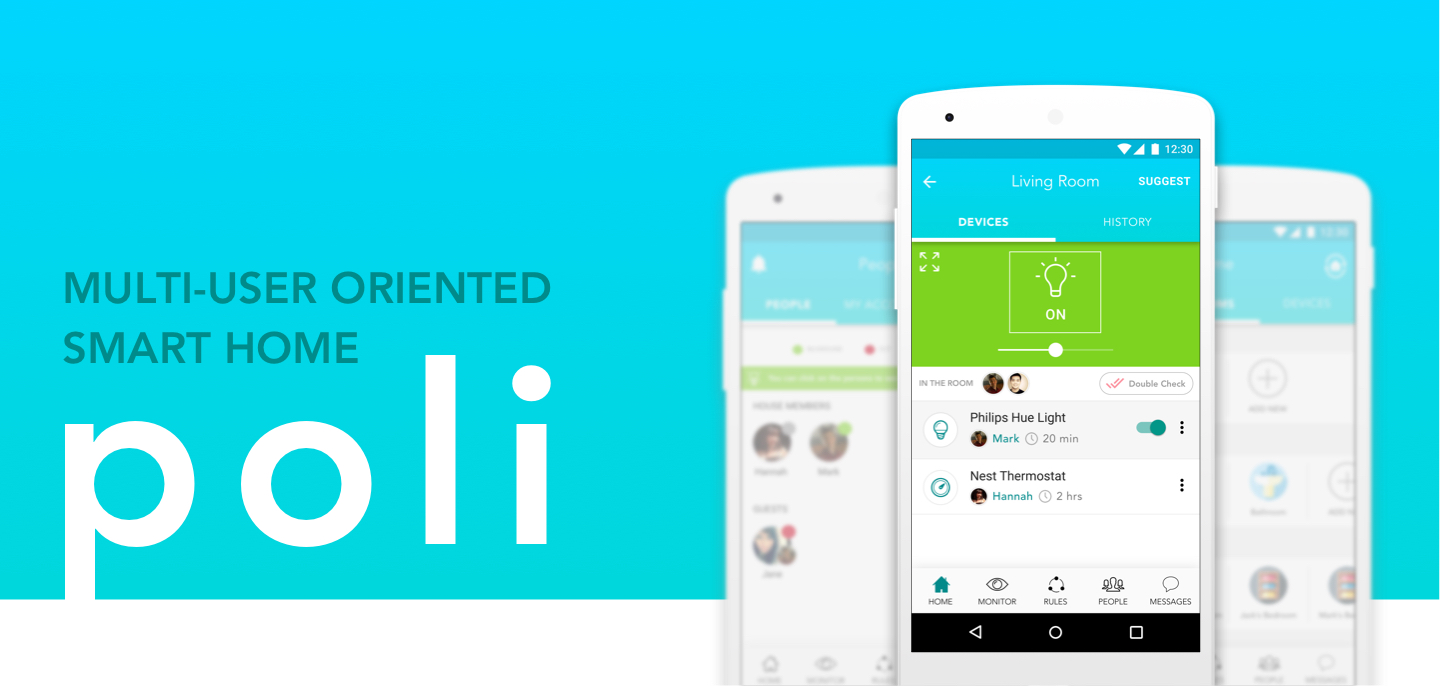
Poli is a smartphone application designed to enhance the user experience of smart home systems for multiple users. By addressing challenges like usage conflicts, transparency, and privacy, Poli enables collaborative and democratic control of smart home devices for roommates, families, and guests, fostering a seamless and socially considerate user experience.
Problem
Smart home systems, typically controlled via personal smartphones, often lack robust support for multi-user scenarios, leading to conflicts, lack of transparency, and limited guest access management. Existing apps (e.g., SmartThings, Google Home) excel in single-user functionality but fall short in participatory decision-making, ownership clarity, and conflict resolution for shared environments.
Key Research Questions:
- How can smart home systems be managed democratically and transparently by multiple users?
- How can ownership of devices and events be defined, especially when owners are unavailable?
- How can the system balance collaboration, privacy, and personalization?
Research
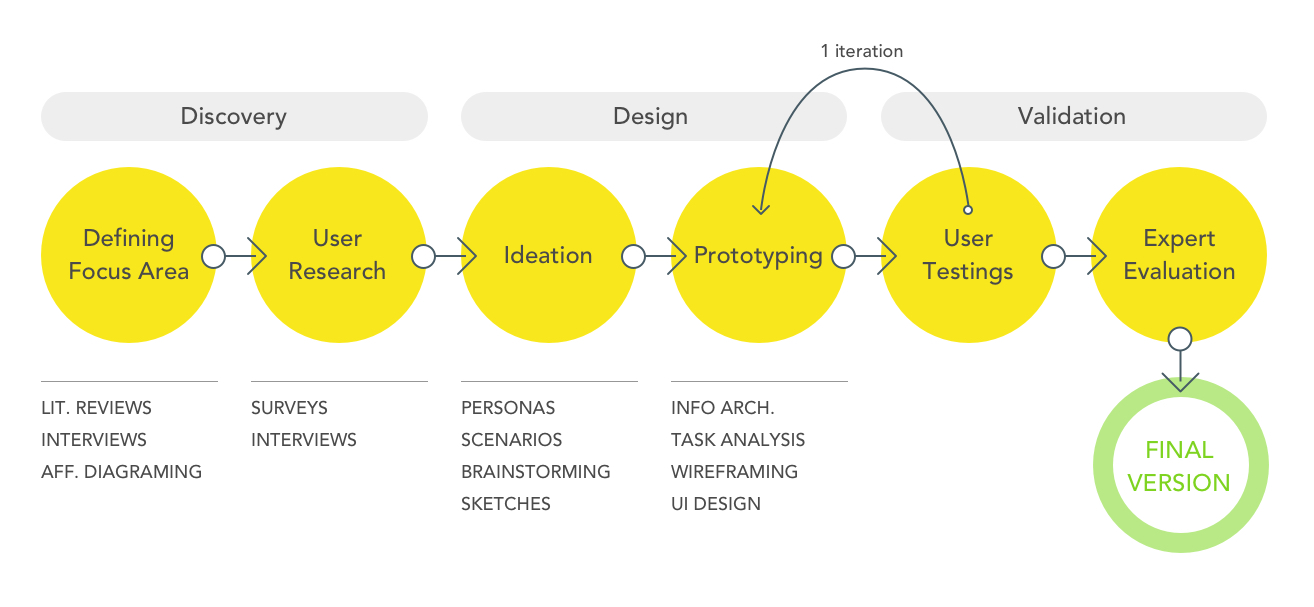
To understand the multi-user smart home landscape, I conducted a comprehensive research process:
Literature Review
I reviewed academic papers, books, and industry articles to identify UX challenges in IoT systems, focusing on interusability, reliability, and multi-user dynamics. Key insights included the need for integrated UX across devices and the importance of natural user interfaces (NUIs) for intuitive interactions.
Informal Market Research & Competitive Analysis
I analyzed popular smart home apps (SmartThings, Google Home, Apple Home, etc.) and found:
- Strengths: User-friendly interfaces, device grouping, and energy monitoring.
- Weaknesses: Limited multi-user features, poor conflict resolution, and inadequate guest management.
User Research
- Semi-Structured Interviews: Conducted with smart home users and IoT experts to uncover pain points like latency, lack of haptic feedback, and the need for guest management.
- Surveys: Two surveys targeted shared household dynamics and smart home usage:
- Survey 1 (Household Dynamics): Highlighted collaboration challenges (e.g., scheduling chores, resolving temperature preferences) and the potential for technology to aid multi-user coordination.
- Survey 2 (Smart Home Users): Revealed that users often share devices but face issues like lack of activity logging and child safety controls.
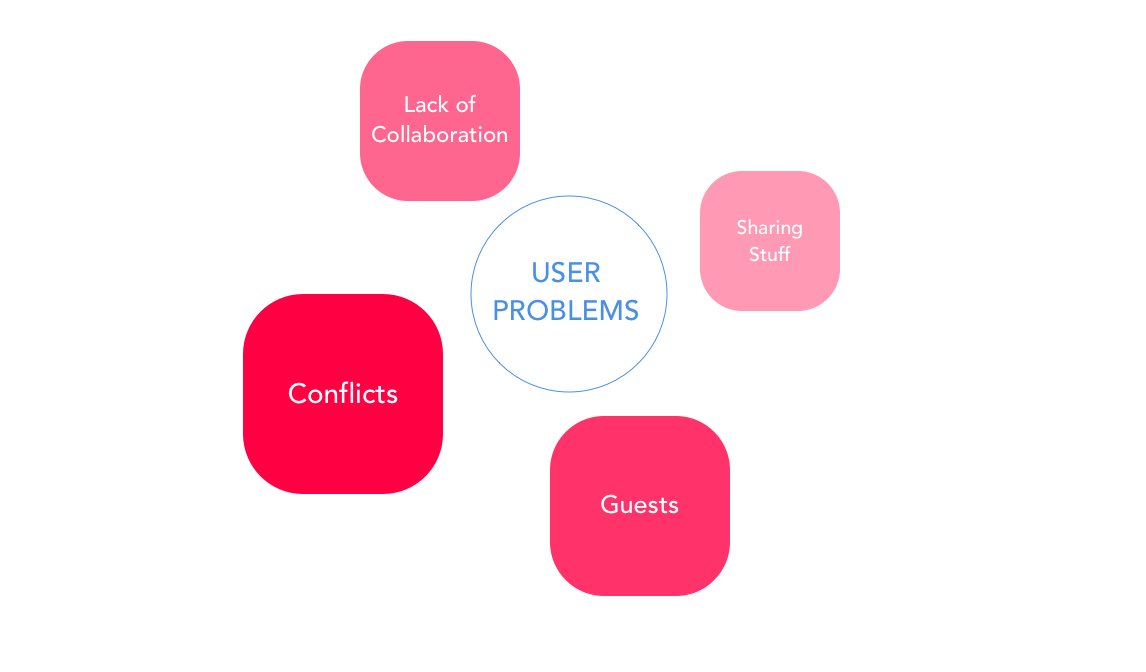
- Key Insights:
- Users value transparency but need privacy options.
- Conflicts arise from instant changes (e.g., lights) more than gradual ones (e.g., thermostats).
- Users desire features like activity logs, guest modes, and voting mechanisms for decisions.
User Personas
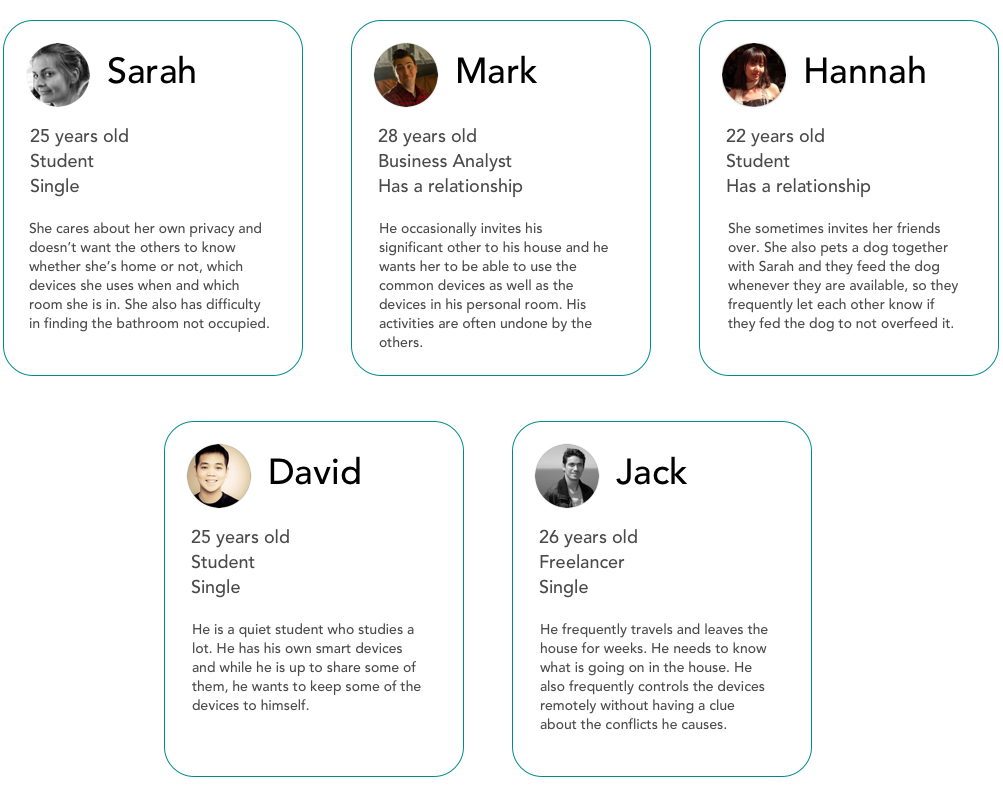
Based on research, I created personas representing roommates (20-30 years old) in a shared house, including diverse roles like owners, regular users, and guests, to guide design decisions.
Ideation
Using Trello to categorize IoT UX aspects (e.g., UI types, interconnectedness, decision-making models), I narrowed the focus to multi-user smart home scenarios in shared households. I brainstormed solutions addressing:
- Usage Conflicts: Alerts for recent changes to prevent overrides.
- Transparency: Activity logs and user presence indicators.
- Ownership: Clear roles (owners, sharers, guests).
- Collaboration: Voting and suggestion mechanisms.
Wireframing
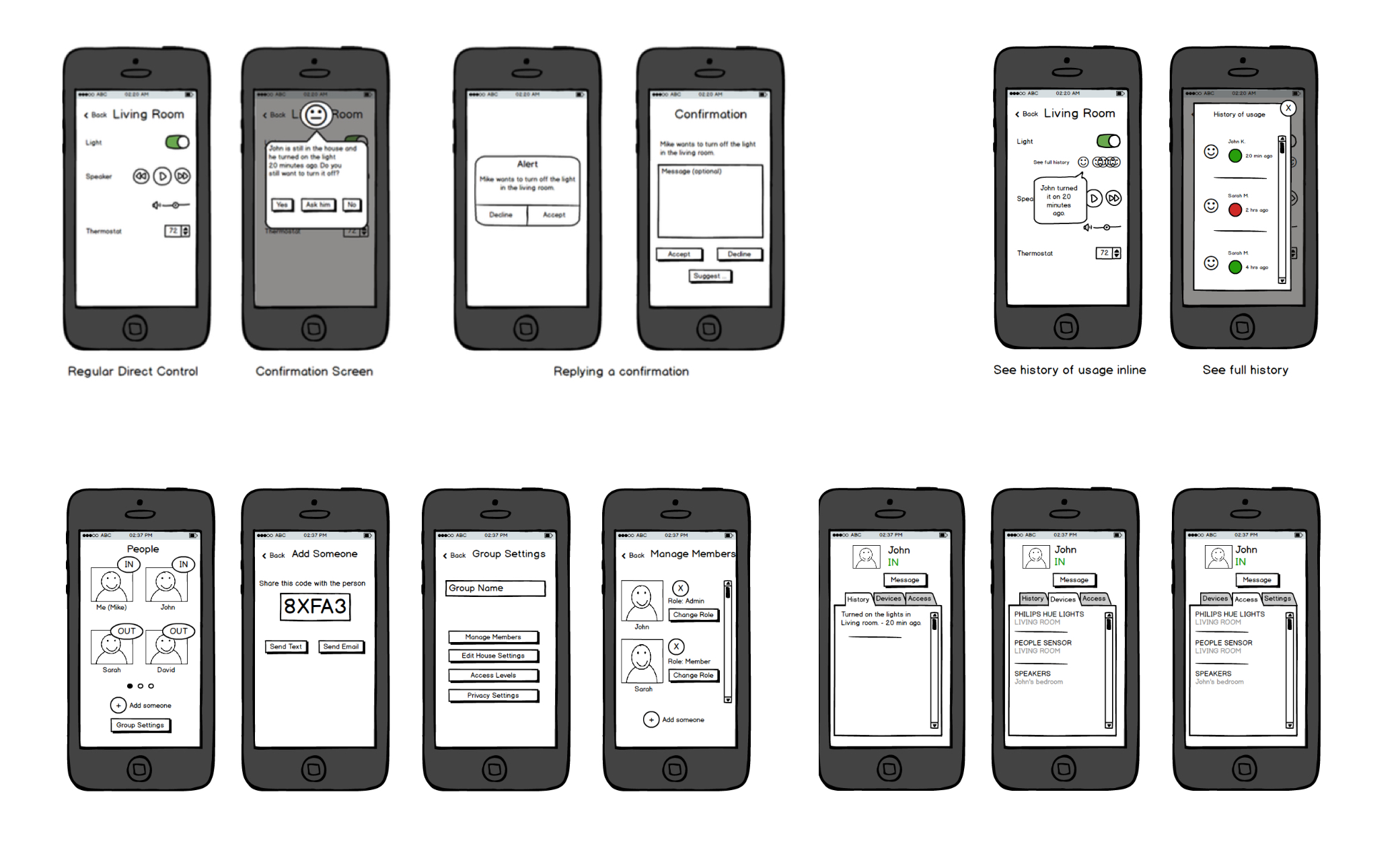
I created low-fidelity wireframes to visualize key interactions:
- Conflict Alerts: Notify users of recent device changes with options to confirm or suggest alternatives.
- Activity History: Quick peeks at recent users and detailed logs.
- User Management: Role assignments (e.g., owner, guest) and privacy settings.
- Suggestions: Voting for proposed changes to resolve conflicts.
Prototyping
I developed two prototype iterations using InVision, adhering to Google Material Design Guidelines for a modern, intuitive interface.
First Iteration (Low-Fidelity)
- Focused on core multi-user features (user management, device control, rule-setting).
- Used realistic input/output methods to test concepts without polished visuals.
- Tested with users to validate hypotheses about collaboration and transparency.
Second Iteration (Higher-Fidelity)
- Refined based on first-round feedback:
- Simplified user roles (e.g., renamed “restricted user” to “guest”).
- Enhanced conflict explanations with context-specific details.
- Improved privacy settings accessibility and clarity.
- Added a “Let Know” feature for household task communication (e.g., notifying roommates about completed chores).
- Polished UI for consistency and cross-platform adaptability (Android/iOS).
User Testing
I conducted two rounds of qualitative user testing with different participants to avoid bias, focusing on five tasks: user management, adding rooms/devices, direct device control, rule-setting, and task communication.
First Testing
- Tasks: Adding users, managing devices, setting rules, and resolving conflicts.
- Findings: Users struggled with unclear labels (e.g., “restricted user”), complex rule-setting, and accessing privacy settings.
- Metrics: Rated tasks on ease (1-7) and time efficiency; hypothesis validation showed moderate support for multi-user features.
Second Testing
- Updates: Added task communication feature, simplified labels, and improved privacy settings flow.
- Findings: Improved ease and time efficiency scores; users appreciated clearer conflict explanations and the “Let Know” feature, though privacy settings placement remained challenging.
- Net Promoter Score (NPS): Added to measure overall product likeability, showing positive user reception.
Expert Evaluation
A senior IoT researcher at Georgia Tech conducted a cognitive walkthrough, suggesting:
- Larger text for privacy settings descriptions.
- More flexible privacy options (e.g., per-person visibility).
- Replacing “owner” with “manager” to avoid confusion.
- Simplifying voting mechanisms for less social awkwardness.
Final Design
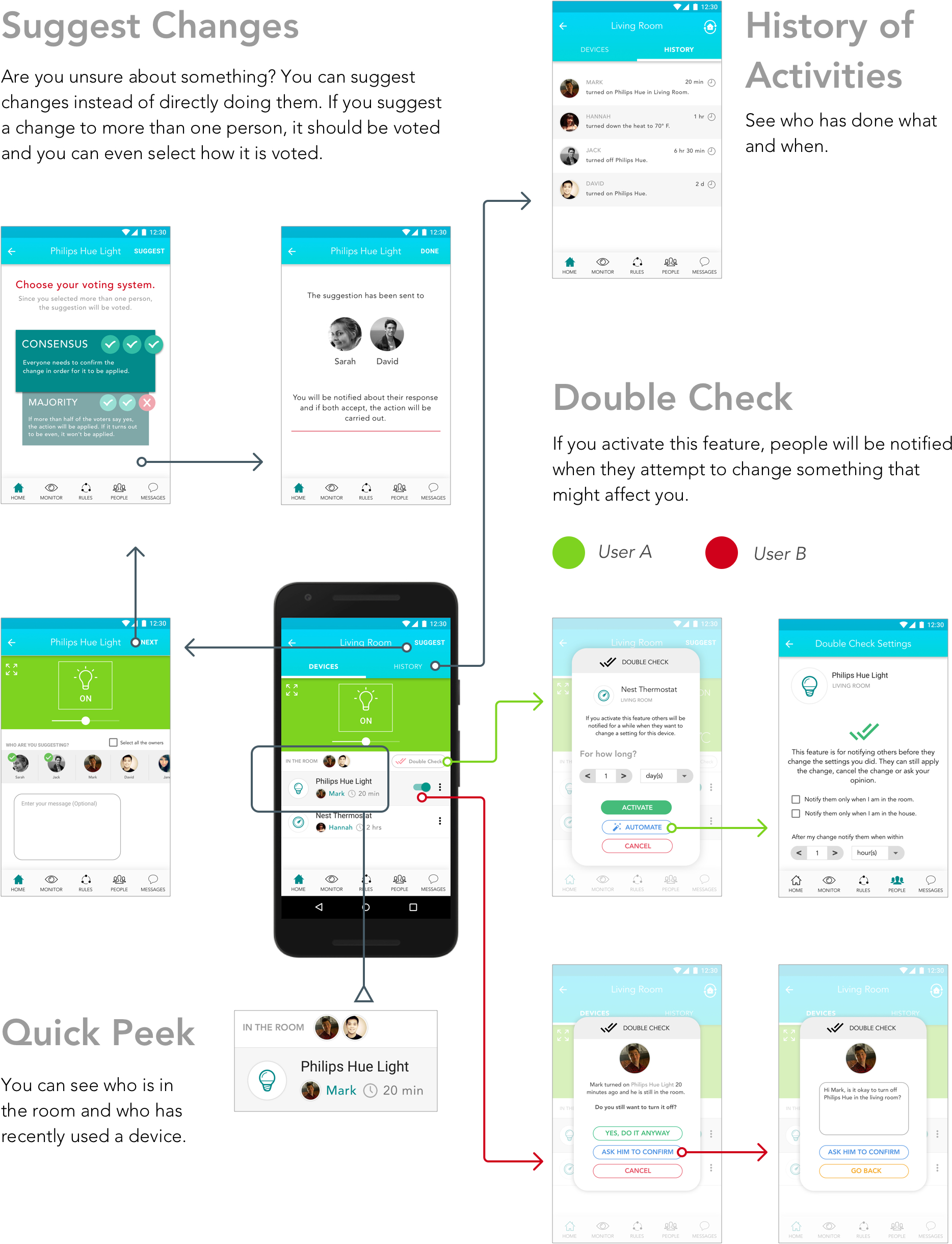
Poli’s key features address multi-user challenges:
- Guest Mode: Allows temporary access for guests with customizable permissions.
- Conflict Resolution: Warns users of potential conflicts with voting or override options.
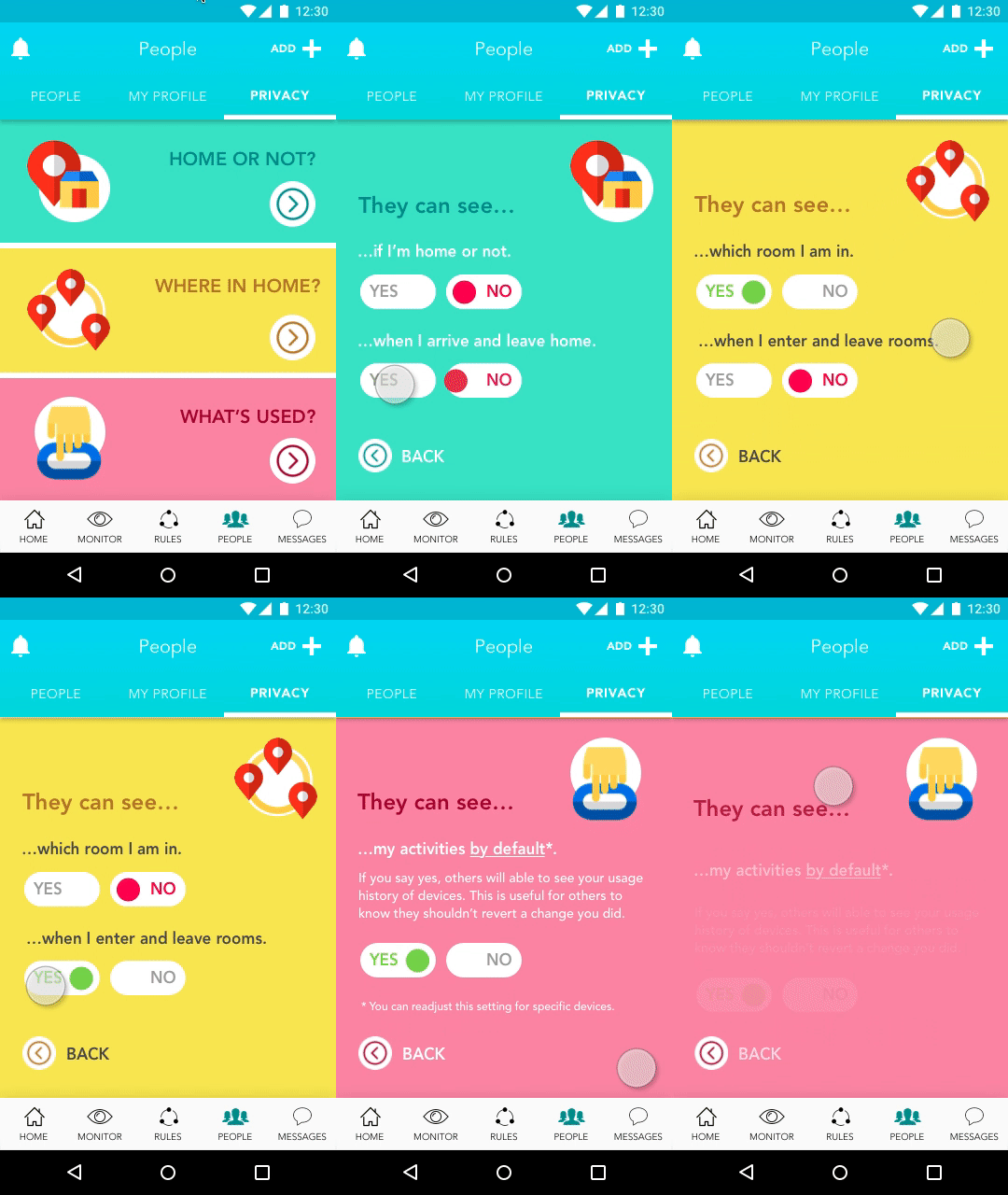
- Privacy Settings: Flexible controls for location and activity visibility.
- Ownership Clarity: Defines “managers” and “sharers” for devices and rooms.
- Quick Peek: Displays recent device users to prevent unintended changes.
- Double Check: Alerts users if a device was recently used, with options to confirm or message others.
- Suggestions: Enables democratic or consensus-based voting for changes.
- Messages & Let Know: Facilitates household communication for tasks like chore coordination.

Microinteractions
Design Principles
Based on research and testing, I derived seven principles for multi-user smart home systems:
- Clear Definitions: Use simple, non-technical terms (e.g., “manager” instead of “owner”).
- Guide, Don’t Restrict: Facilitate collaboration without overriding user autonomy.
- Explain Conflicts: Provide specific reasons for conflicts to aid resolution.
- Balance Transparency and Privacy: Ensure visibility with flexible privacy options.
- People-Centric Rules: Base rule-setting on users, not devices, for intuitiveness.
- Integrate Household Management: Optionally include task coordination, ideally tied to devices.
- Minimize Social Awkwardness: Avoid overly rigid systems that hinder natural communication.
Outcomes & Impact
Poli offers a user-centered solution for multi-user smart home management, addressing gaps in existing apps by prioritizing collaboration, transparency, and privacy. User testing showed improved task efficiency and positive feedback on features like guest mode and conflict resolution. The design principles provide a framework for future IoT applications, emphasizing intuitive and socially considerate UX.
Future Directions
- Children’s Roles: Explore restricted roles for younger users.
- Enhanced Privacy: Offer anonymized presence indicators (e.g., number of people in a room).
- Recording Devices: Address privacy concerns for cameras and microphones in shared spaces.
Reflections
This project honed my skills in user research, iterative prototyping, and stakeholder collaboration. Balancing technical complexity with user needs taught me to prioritize clarity and flexibility in design. Engaging with real users and an IoT expert validated the importance of iterative testing to refine solutions for complex, multi-user environments.
© DESIGNED by MEHMET DERYA ORDU | 2025